Bob Marshall ranks among the most influential advocates for wilderness preservation. He was also a prolific, record-setting peak-bagger. These two facts are closely related: Marshall’s work on wilderness philosophy is a reflection of his recreational activity. Because of the intensity of his recreation, emulating his activity is difficult, but doing so provides an intimate understanding of his wilderness philosophy.

Great Range from Big Slide
Wilderness Philosophy
Marshall’s arguments for wilderness protection are unlike other influential advocates for preservation, such as Muir, who compared wild places to temples. Marshall’s arguments are fundamentally utilitarian, stressing the benefits of wilderness recreation, chiefly those of physical strength and mental health.
Most people, he claims, have a deep psychological need for adventure that the ordinary institutions of civilization cannot satisfy. Life without a chance for adventure, he says, would be “a dreary game, scarcely bearable in its horrible banality” (Marshall, The Problem of the Wilderness, 1930, p. 143). Our need for adventure, Marshall explains, is why many people are enthusiastic about war (p. 144). On this view, the Army’s “be all you can be” campaign, for example, presents a rare opportunity for those craving extreme excitement. Writing in the spirit of the American pragmatist William James, Marshall’s suggestion is that the wilderness offers a “moral equivalent of war” (p. 144). Wilderness, by providing a site for a civil form of high adventure, holds the promise of happiness.
For Marshall, the term “adventure” is rigorously understood: it “implies breaking into unpenetrated ground, venturing beyond the boundary of normal aptitude, extending oneself to the limit of capacity, courageously facing peril” (Marshall, The Problem of the Wilderness, 1930, p. 143). As such, an adventure is an extraordinary undertaking, wherein the limits of human possibility are redefined.
If we take Marshall’s vocabulary seriously, wilderness adventure is an extremely risky endeavor. Marshall defines “wilderness” as follows: “a region which contains no permanent inhabitants, possesses no possibility of conveyance by any mechanical means and is sufficiently spacious that a person in crossing it must have the experience of sleeping out” (p. 141). Further, one of the dominant attributes of wilderness is that “it requires anyone who exists in it to depend exclusively on his own effort for survival” (p. 141). In a wild place, where physical capacity is a vital resource, pursuing adventure, i.e., “extending oneself to the limit of capacity,” may very well put one’s life in jeopardy.
It all sounds too intense, perhaps even ridiculously macho. Surely there are other ways to appreciate the wilderness. Nonetheless, Marshall’s wilderness philosophy was, for him, an earnest practice. He quite literally put his own life at risk to satisfy his appetite for adventure. Even a known heart condition did not deter him from pursuing his recreational objectives. Tragically, a trip in the Cascades in 1939 might have contributed to his fatal heart attack two months later (Nash, The Strenuous Life of Bob Marshall, 1966, p. 20). He died at age 38.
The Big Day
On July 15th, 1932, in a race to climb the greatest number of high peaks (peaks over 4000ft.) in a day, Marshall climbed thirteen high peaks in 19 hours. His plan went as follows: start at John’s Brook Lodge at 3:30am; hike Big Slide before sunrise; return to John’s Brook Lodge for breakfast; then proceed to traverse the entire Great Range, from Lower Wolf Jaw, to Upper Wolf Jaw, to Armstrong, to Gothics, to Saddleback, to Basin, to Haystack, and on to Marcy; have lunch on Marcy; descend the south side of Marcy to climb Skylight; next, by way of Lake Colden, ascend the steep path to Iroquois and MacIntyre (Algonquin); on the way out, bag Wright before sunset; and finally, cap off the day by climbing Mount Jo (not a high peak) in the dark, to return to the Adirondack Loj for dinner. This historic route is approximately 31miles in distance and over 14,000ft of cumulative elevation gain. It is known as the Bob Marshall Traverse (BMT), or simply “The Bob.”
I had been thinking about this route for a few years. Having read all about Bob’s sense of adventure, I imagined his traverse to be impossibly hard, and, frankly, I was a little scared of it. Finally, on July 2nd, 2024, I went after it.
On this day, there was over fifteen hours of daylight. It was mostly clear and calm all day and night with temperatures in the 50s and 60s. Trails were wet from rainy days prior, with runoff on rock slabs and mud bogs all over.
Instead of staying at John’s Brook Lodge (JBL), where the route begins, I started at 2am from the Garden parking in Keene Valley, which is 3.5 miles out. I did not record the first 3.5 miles.
My plan was to meet a friend at JBL at 3:30am. My friend would hike Big Slide with me before dawn, do his own thing, drive to the terminus of the route, the Adirondack Loj, and hike Mount Jo with me after dusk. We would stay at the Loj together, and the next morning he would give me a lift back to the Garden.
I arrived at JBL a bit early and filled up with water. It was nice to see my friend’s face at that dark hour in the woods. I started my GPS at 3:23, and we began, back the way I came, to the Big Slide junction.
Bob wrote about his hike in High Spots, a publication of the Adirondack Mountain Club. In that article he includes a table of the peaks with the times of arrival. I used Bob’s times to measure my own progress.
Remarkably, my time up the first peak matched Bob’s time to the minute. So, like Bob, I got to experience the sunrise on Big Slide. On the summit of Big Slide, I said goodbye to my friend.
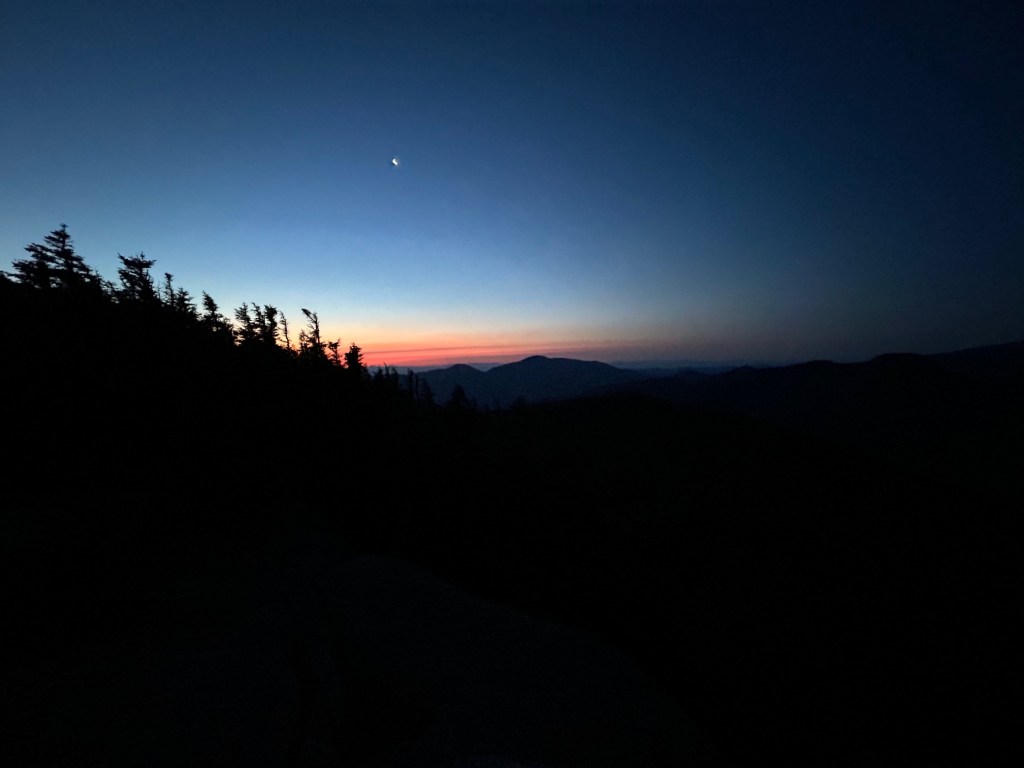
Sunrise on Big Slide
Bob says that on the way back down to the valley, he broke into a run and felt sure he could climb fourteen mountains in a day (Marshall, Adirondack Peaks, 2006, p. 67). Although I felt fresh and energized by the rising sun, I lacked Bob’s youthful confidence.
Bob returned to JBL in the valley for a hot breakfast. I did not. So, on Lower Wolf Jaw, I was actually ahead of schedule by about ten minutes.

Big Slide from Lower Wolf Jaw
Surely the trails have changed over the years, but in my mind Bob’s description of the trail to Upper Wolf Jaw—that it “shoots straight up cliffs, stumbles over all sorts of tree roots and skirts through narrow crevices among the rocks”—applies equally today, nearly a century later (p. 67).
On Upper Wolf Jaw, I realized that I was beginning to fall off Bob’s pace. I was only one minute ahead.
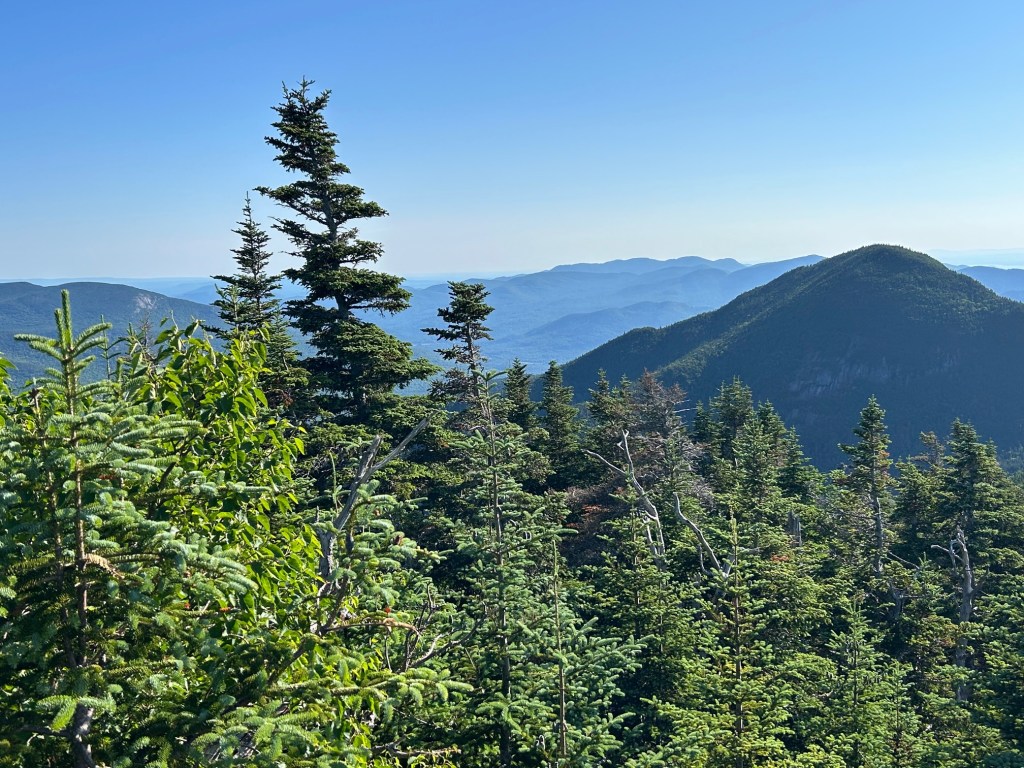
Lower Wolf Jaw from Upper Wolf Jaw
Then, on Armstrong, I was five minutes behind, oh no!

Onward to Gothics from Armstrong
And eight minutes behind on Gothics! An irreversible trend? I did deliberately stop on each summit to resupply my pockets with snacks, record my time, take a picture, etc., but I wasn’t hanging around. I wore a hydration pack for water and ate on the go. And yet I was slowly falling behind.
I had a fresh pair of socks in my pack and kept thinking that when I made it through the muddy sections, I would put them on. The muddy sections just kept coming. My feet were wet all day.
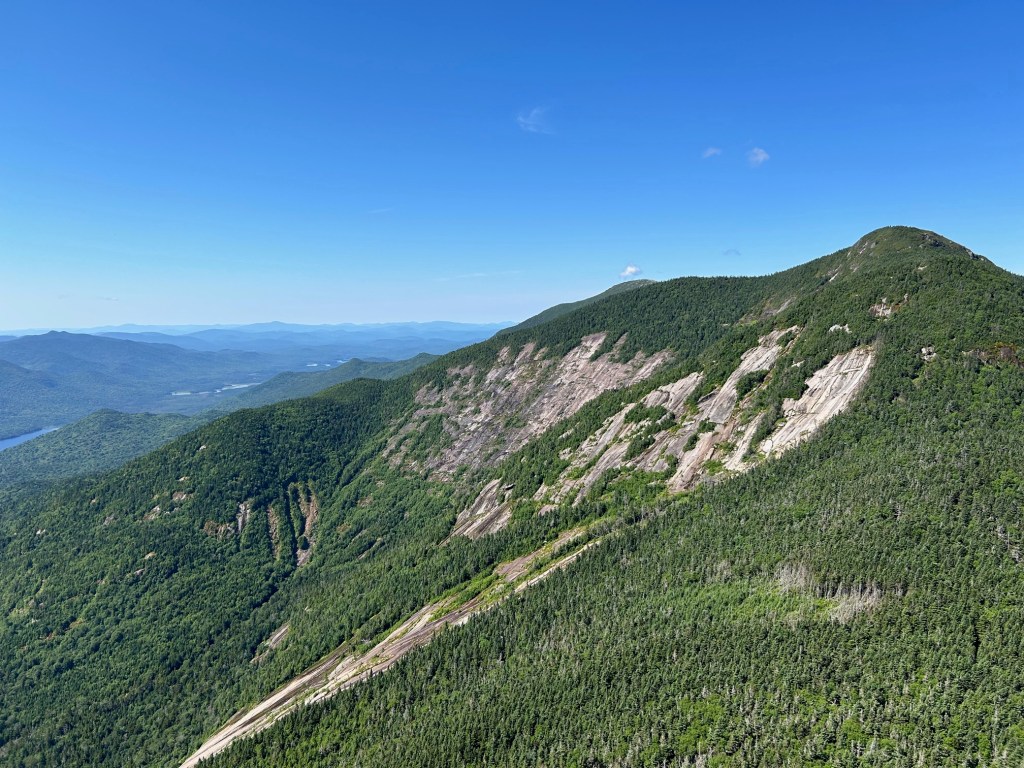
Basin from Saddleback
I lost five more minutes on the way to Saddleback but was feeling good. I enjoyed downclimbing the Saddleback cliffs. Thankfully that aspect of the mountain was dry and grippy. I gave nothing up on Basin. Still thirteen minutes down.

Haystack, Skylight, and Marcy from Basin
In between Basin and Haystack, I stopped to filter some water.
When Bob was on Haystack, he had recently returned from Arctic Alaska, and he wondered whether he would recapture the experience of wildness. “Gloriously enough” he writes, “It was still possible to forget the automobiles and machinery” (p. 68). Maybe it’s not the most relevant, but I saw two women eating ice cream on the summit of Haystack!
This was my second time traversing the Great Range. My first time, I started from Rooster Comb, and in my memory, the push over to Haystack was trying, like miles 18-20 in a marathon. Interestingly, a decade later, this is where I started to feel it. The scarry thing was that on my current route, Marcy would be the mental half-way point, and not the final peak. On Haystack I was twenty-five minutes down.

Skylight and Marcy from Haystack
Herbert Clark, the Marshall family guide and 46er #1, brought lunch to Bob on Marcy. Before the hike, I anticipated Marcy’s summit to be decisive because the route goes over the top and down the other side, away from the Garden. At the time, however, my momentum made the decision for me. Absent any objective problems, I continued without much pause. Twelve hours into my activity from the Garden, I was only 20 minutes down. That much time might be attributed to chit chat, I thought. The trails were fairly busy for a Tuesday.

Colden and Algonquin from Marcy
On the way up Skylight, a descending trio told me that they heard that the trail to Lake Colden was “swamped out.” When I replied, “it’s passable, right,” they responded in a way that, in retrospect, provides a fitting commentary on my hike: “Yes, but we’re not animals; we are out to enjoy ourselves.”
I guzzled a mini can of Coke on the summit of Skylight. It was now time to cover some distance. Skylight is 16.5 miles into the BMT. The junction to Algonquin, on the far side of Lake Colden, is at about mile 21.
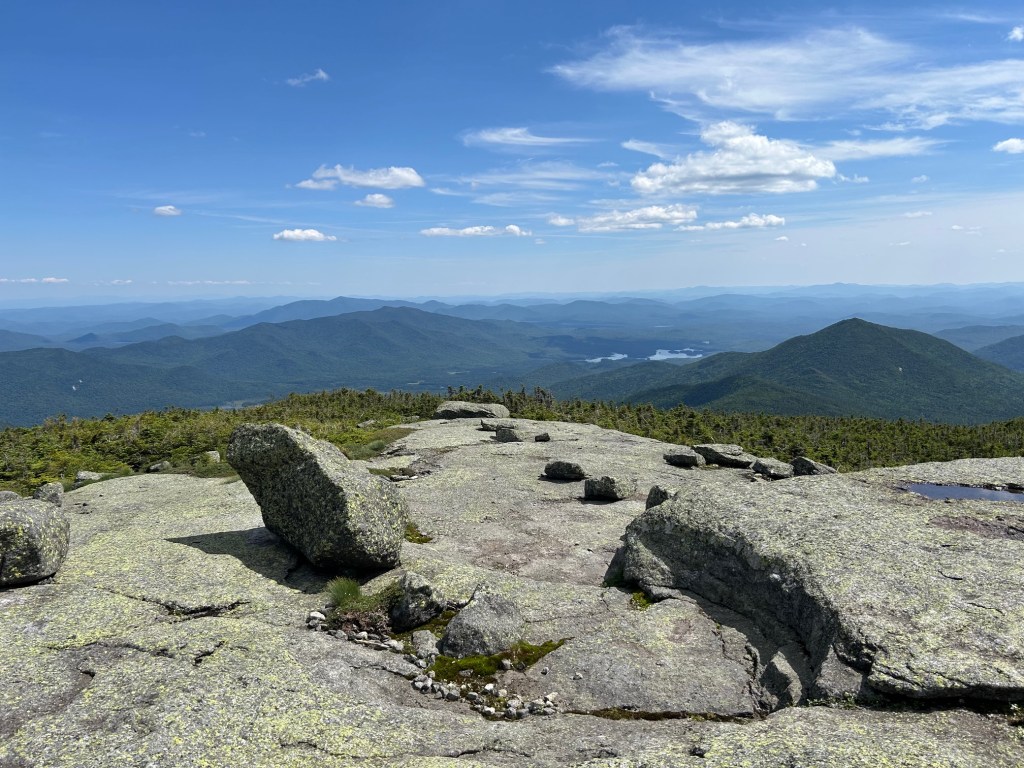
Allen (right) from Skylight
This section was easy, automatic walking, but wet trail conditions dashed any remaining hope of keeping up with Bob. Before arriving at Lake Colden, I stopped one more time to fill up on water. Bob must have been cruising through this section, because now I was a full hour and a half behind.

Lake Colden
The junction to Iroquois and Algonquin marked a significant commit or bail decision point. Unlike my one-foot-in-front-of-another decision-making approach on Marcy, here I needed to be calculative. Like Bob, I wanted to finish, or nearly finish, the high peaks before dark. The ascent from the junction to the height of the MacIntyre range is 2,300ft in about 2 miles. It took Bob about two hours to get to Iroquois from there. It was 5:37pm. I thought that if I pushed it, I could be on the downslope of Algonquin by dark, so it was a go.
This was certainly the most grueling part of the entire BMT. I worked as if it were an emergency. The odd thing is that in a real emergency, I would have taken the easy way out. By refusing to take the exit, I voluntarily put myself in a situation that was beginning to feel like an emergency. Pushing my limits, I was growing more familiar with Bob’s definition of “adventure.” But at that time, in that place, on the rugged path on the far side of Algonquin, I was no longer enjoying myself. I was working like an animal. But what strange animal would put itself in that situation?
Under two hours, I arrived at the col between Iroquois and Algonquin. Forgetting that Boundary Peak obscured the view of Iroquois, I didn’t hesitate to turn toward Iroquois. The summit looked so close. That mistake made Iroquois feel farther out than ever before. I arrived at 7:40pm.
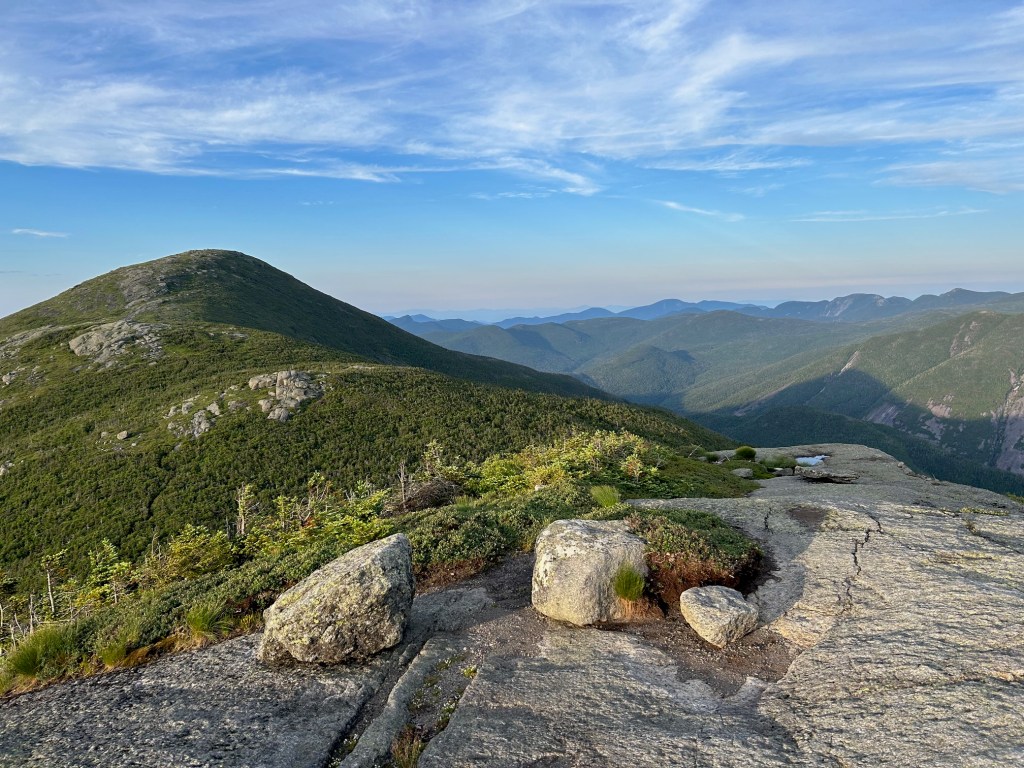
Algonquin from Iroquois
The sun was going down. The wind was picking up. I hadn’t seen anyone else on the trail since Lake Colden. I rushed up and over Algonquin.
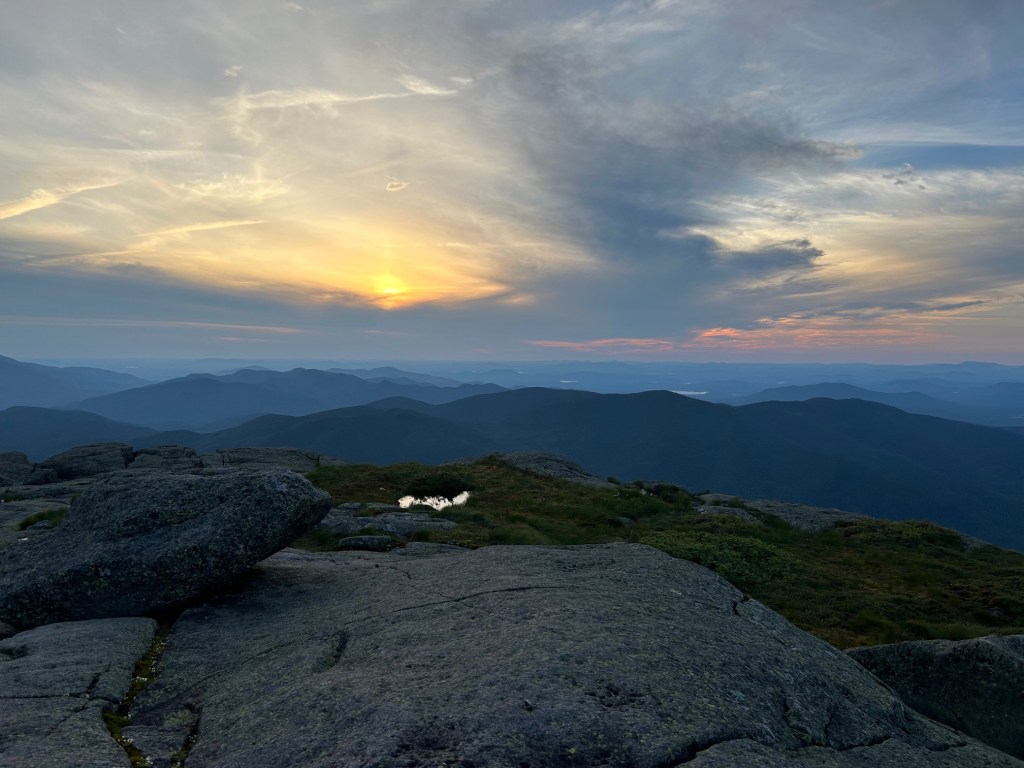
Sunset on Algonquin
When I got to the Wright junction, I was assured that it is only .4 miles from there to the summit. If it were any longer, I might have been discouraged. On the ascent above treeline, I could still make out the shadowy cairns, but on the summit at 9:30pm, it was dark and windy. For the first time that day, I used my GPS to help navigate. I also used its satellite communication to tell my friend at the ADK Loj that I would be a couple more hours.
The exit from the Wright junction is a blur. I may have been sleepwalking and dreaming of stepping from boulder to boulder. By the time I reached the parking area, I was so out of it that it took me 15 minutes to find the Loj.
Reaching the Loj at 11:30pm, I immediately saw the silhouette of my friend through the window. He was patiently waiting in the common area, ready to hike Jo. He had checked me into my room. He even bought me a cheeseburger and put it in there with my other stuff. I am super grateful for his support. The hike up Jo at midnight passed quickly in his company, even though it took us nearly two hours, round trip.
All total, I was out hiking for nearly 24 hours, my longest single activity. Elapsed time on the BMT (excluding the walk from the Garden) was 22:09, Moving time was 18:43. Anyway you count, it was a long time. There are elite trail runners who are doing this route twice as fast. Abundant kudos to them. They are animals. I trust that they have proven themselves in the context of ultra running before trying it in the “wilderness.”
Marshall published “The Problem of the Wilderness” a couple years before his big hike. On Bob’s own terms, it is questionable whether his hike constituted a wilderness adventure. His hike was record-setting, so it did explore and expand the limits of human possibility. In that sense it was an adventure, although I wonder how hard Bob had to work for it. The paradox is that pursuing his sense of adventure, he rendered the wilderness nonexistent: the hike itself demonstrates that the High Peaks Wilderness can be traversed in a day without sleep, and therefore it is not sufficiently spacious on Bob’s definition.
Another characteristic of wilderness is that it requires self-reliance. The appetite for adventure, basically defiant of physical limitations, potentially undermines self-reliance. In this light, wilderness adventure appears to be a perverse game of designing a vitally challenging situation to test one’s powers of self-reliance. Perhaps there is a self-destructive side to the athletic achievements that we tend to glorify. Emulating the BMT made me reevaluate the importance of wilderness adventure. In remote areas, the prudent move is to nourish a reserve capacity, as a resource for emergencies, not to extend oneself to the utter limit of capacity.
Sources
Marshall, R. (1930, February). The Problem of the Wilderness. The Scientific Monthly, 30(2), 141-148.
Marshall, R. (2006). Adirondack Peaks. In P. Brown (Ed.), Bob Marshall in the Adirondacks: Writings of a Pioneering Peak-Bagger, Pond-Hopper and Wilderness Preservationist (pp. 64-69). Saranac Lake, N.Y.: Lost Pond Press.
Nash, R. (1966, October). The Strenuous Life of Bob Marshall. Forest History Newsletter, 10(3), 18-25.

 Aaron C. Vlasak
Leave a reply to vlasakac Cancel reply